Showing posts with label Semester 2 2008. Show all posts

Friday, May 29, 2009

Good luck


I'm trying to re upload the cell, tissue, and organ files.


Because some of you said you have trouble with it.


TISSUE-still failed


do not over sleep in your study and your test day....OK?!


For further information, please send your email to miss.maria.irawati@gmail.com


Monday, February 23, 2009

Remedial and make up test chapter IV

To all students who have score <6 for Plant classification daily test:

Remedial:
date : Wednesday/ February 25th, 2009
time: first break
location: AV SMP

Make up test
date : Wednesday/ February 25th, 2009
time: second break
location: AV SMP

Please prepared yourself, you may bring food from home and eat it during the remedial and the make up test.

If you need further information, I'll be at the science room during the first break and second break tomorrow (Tuesday: February 24th ,2009). You can ask about anything related to Plant classification which you haven't understand yet. It will be my pleasure to help you.


for all grade 7:
material for mid semester test:
  1. Plant classification
  2. Cell, organelles, and microscope
See you and GBU

For further information, please send your email to miss.maria.irawati@gmail.com

Tuesday, January 20, 2009

Plant Classification

When asked to visualize what a plant is, many of us picture sun flower or mango tree. We think of "plants" as having roots, a stem (or trunk), flowers, fruit, and seeds. Most of us do not automatically think of the plants that grow on rocks, rooftops, the wall of some home, and any other damp and shady area; however, this unusual plants are exists. Their leaves are mostly one cell thick, they have no true roots, stems, flowers, or fruit, and instead of seeds they have spores. "They" are the mosses; the plants we see forming "green carpets" with thin wiry upright stems supporting a brown capsule that appears to be wearing a hat.

The plant kingdom includes seed plants, ferns and mosses. Plants can have one cell or many cells. Their cells are eukaryotes and have cell wall. Plants make their own food (autotroph) by producing simple sugars through a chemical process called photosynthesis. Most of the food produced by plants is made in the leaves. The leaves provide ample surface area for the absorption of light energy and contain many chloroplasts and it is in the chloroplasts where photosynthesis occurs.

The plant kingdom includes one celled organisms (diatoms) as well as complex organisms like angiosperms. Some plants and trees have vascular tissue (xylem and phloem) or well-developed conducting tissue through which water and nutrients are transported to various parts of the plant. “Xylem” (water carrying stem tissues) and “Phloem” (nutrient and carbohydrate carrying stem tissues) plants are called “vascular plants”. Other plants are non-vascular (bryophytes) and do not possess internal transport systems. Vascular plants, however, live on land and possess special features adapted to this environment such as roots, stems and leaves.


Mosses (Bryophyta)

They have no vascular system so must directly absorb water from the soil. Mosses have root-like rhizoids (rhizo = root; -oid = like, form) and leaf-like structures, but these are not true roots/leaves because they have no vascular system. Mosses reproduce by spores, which are analogous to the flowering plant's seed; however, moss spores are single celled and more primitive than the seed. Spores are housed in the brown capsule. As the spores ripen they are dispersed from the capsule, and some land in areas where there is enough moisture for them to grow. The young moss looks like a very thin tangled mass of branching green hairs. Buds will appear next on the green hairs, from which tiny stalks and slim leafy gametophyte will grow. Mosses also have different mechanisms they use for acquiring nutrients. Some mosses are able to take up nutrients from water flowing over them, thus they have very effective absorptive surfaces. Other mosses, take nutrients directly from the soil or substrate on which they are growing and transfer the nutrients to their growing tips. Mosses can be found around hot springs, at the bottom of lakes, on rocks, and trees. And of course we know that mosses grow in moist temperate forests, mosses grow on our trees, sidewalks, garden, rooftops, and everywhere in between. The two main requirements of a moss are sufficient moisture and accessible nutrients.
Unknown to most of us, mosses actually have many uses, from ecological to medical with a suite of common household uses in between. They lay the foundations for other plant growth, prevent erosion, and contribute to the lush green appearance of many forested areas. Throughout history mosses have been used in horticulture because they are beneficial to the soil. Mosses increase the amount of water soil can store and improve soil's nutrient holding capacity.

Ferns (Pterydophyta)


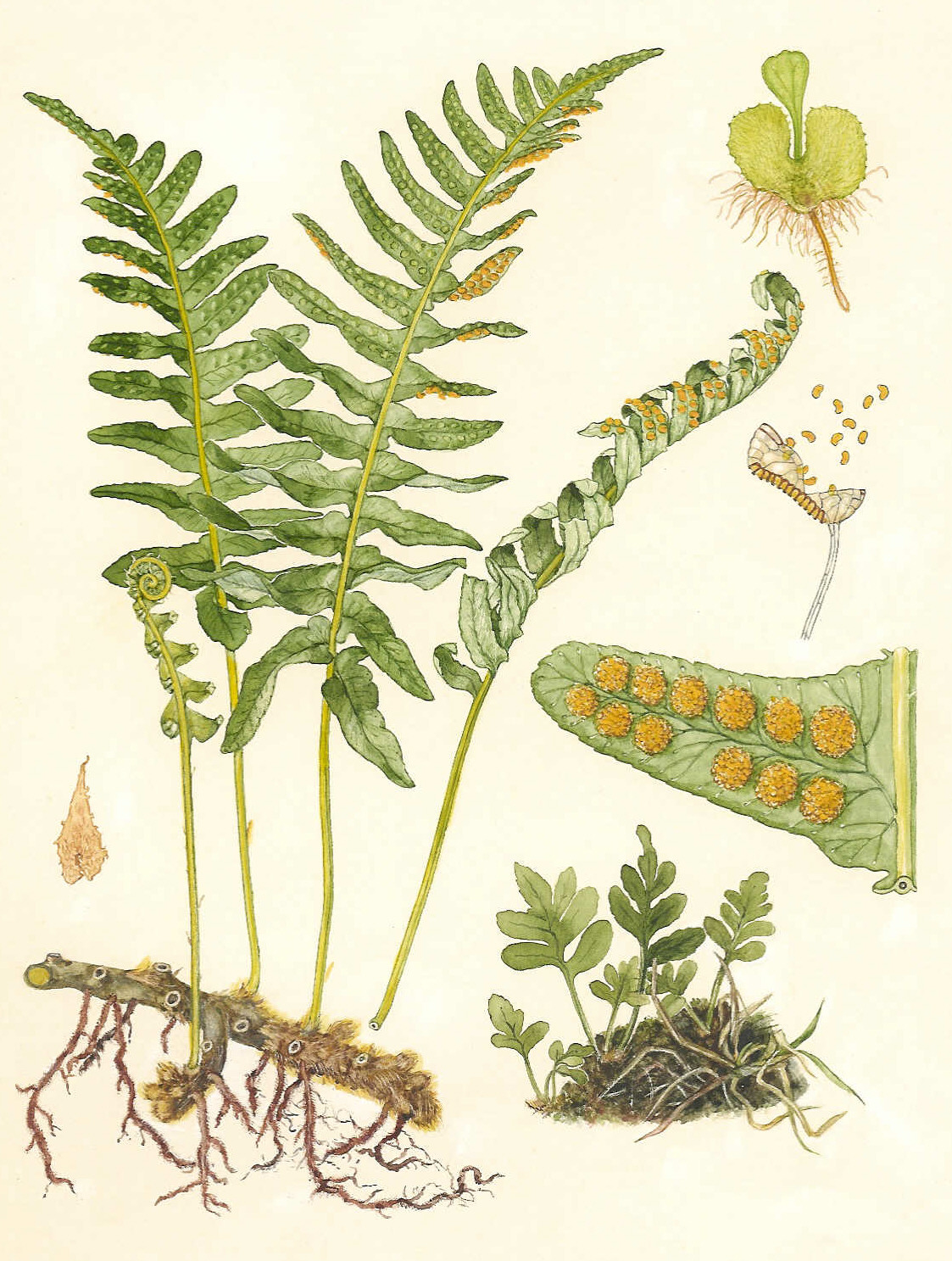
Ferns have a vascular system to transport fluids through their bodies but like the mosses, they reproduce from spores. Ferns reproduce through primitive "seeds" called spores which are produced by the small pumps on the back of older leaves. The dark brown, tiny spores are single cells that will develop into plants if they land in the perfect environment. They have underground structure called rhizome, fleshy stem that grows horizontally, as a food-storing organ, beneath the surface of the ground, and enables a plant to reproduce itself.

Conifer (Gymnosperms)


The gymnosperms add the next level of complexity to plant evolution: they reproduce from seeds instead of spores. The seeds, however, are "naked" (Greek: gummnos) – they are not covered by fruit. Usually, the seed is produced inside a cone-like structure (female cone has brown color while male cone has yellow color in the picture above) such as a pine cone where comes the name "conifer." The seeds are inside the scale of female cone. Female cone has brown color while male cone has yellow color in the picture above. Some conifers, such as the Yew (cemara) and Ginko, produce their seeds inside a berry-like structure.
Conifers are fairly easy to identify: In addition to the cones, these trees and shrubs typically have needle-like, scale-like leaves. And they never have flowers.

Angiosperms

Angiosperms are the dominant members of the world's flora. Angiosperms are flowering and fruit producing plants. Angiosperms add the final improvement to plant reproduction: they grow their seeds inside an ovary (Greek: angeion = vessel) which is, itself, embedded in a flower. After it is fertilized, the flower falls away and the ovary swells to become a fruit. The angiosperms may be divided into the monocots (Monocotyledoneae) and the dicots (Dicotyledoneae).

Monocots have only one cotyledon, dicots have two cotyledons. A cotyledon contains stored food and serves as a food reservoir. Aside from the difference between the seeds of monocots and dicots there are other different structures that separate monocots and dicots. Monocots have long, narrow leaves with parallel veins (such as grasses). The parts of monocot flowers are arranged in threes or in multiples of three. Dicots have broad leaves with branched veins (network vein)
The parts of dicot flowers are arranged in fours and fives or multiples of fours and fives. Monocots have soft stem while dicots usually woody.
Monocot has scattered vascular bundle arrangement, while dicot has vascular bundle arrange in a ring like shown in the picture below (monocot: left side, dicot: right side)

Roots:
1. taproots, have a single large root that grows straight down, with numerous smaller lateral roots.→dicots
2. fibrous roots, smaller branching roots that consisting of resembling fibers→monocots


Monocots provide us with our primary sources of nutrition, supplying us and the animals we eat with grains such as wheat, oats, and corn, as well as fruits such as dates and bananas.
Kingdom: Plantae
  1. Non Vascular Plant: Mosses (Division:Bryophyta): Don’t have xylem and phloem, have rhizoid
  2. Vascular plant:(Have xylem and phloem=vascular bundle)

       2.a).Seedless plant: Ferns (Division: Pterydophyta ): Reproduce by spore, have rhizome
       2.b).Seed Plant (Spermatophyta ): Reproduce by seed
 
            2.b.i) Non Flowering Plants (Gymnospermae): Naked seed, seed in the female cone 
             2.b.ii)Flowering Plants (Angiospermae): Seed in fruits

Look at these flowers, based on their characteristics, they are belongs in which group of plant? Observe...^ ^
Lily:

Hibiscus:
Jasmine:


Do it at your exercise book:
1. What is a plant?
2. What is vascular plant?
3. What is xylem?
4. What is phloem?
5. What are the characteristics of Bryophyta?
6. What are the characteristics of Pterydophyta?
7. What are the characteristics of Gymnospermae?
8. What are the characteristics of Angiospermae?
9. What are the differences between monocots and dicots?
10. What are the differences between mosses and ferns?
11. Give three examples for each number 5-9!
12. Where do they live (no 5-9)?
13. What is cotyledon?
14. What is rhizoid? In which group of plants do you find it?
15. What is a rhizome? In which group of plants do you find it?

Do it at your note book!
Make a diagram/brain storming of plant classification based on the article above!

http://biology.unm.edu/ccouncil/Biology_203/Images/FloweringPlants/MonocotDicotStemOverview.jpeg

For further information, please send your email to miss.maria.irawati@gmail.com

Saturday, January 10, 2009

Plant Classification-Assignment 2

Dear all,

After we discuss ferns and mosses you brought to the lab last friday......

( My best compliment to 7 B who brought exelent samples too the lab and no groups forgot, 7C....thank you for trying to do your best but I hope next assignment you could be more prepared and take the responsibility as a group)

our next assignment........
(7B: Wed, 14th January 2009, 7C: Mon, 12th January 2009)
  • type: group task
  • location: Biology Laboratory
  • Assignment:
  1. bring sample of flower, leaf, and stem of dicots plant (minimum one for each)
  2. bring sample of flower, leaf, and stem of monocots plant (minimum one for each)
  3. bring sample of dicots plant's root (minimum one, clean and not in the soil; for bonus point)
  4. bring sample of dmonocots plant's root (minimum one, clean and not in the soil; for bonus point)

All of the samples might be taken from different kind of plant as long as you know the name of the plant (ex: flower from rosses, leaf from grass and the stem from mango tree^ ^)

And please, don't bother to ask rosses are dicots or monocots,
thats you too decide and will be part of your score for this assignment.
You can find out by reading your previous note or ask your friends and family, or......find yourself via books or internet

NB: special assignment for 7C and I_ _

happy searching.............^ ^


For further information, please send your email to miss.maria.irawati@gmail.com

Wednesday, January 7, 2009

Plant Classification-Assignment-Revision

Dear all 7 Grade (7E, 7C, and 7B),

this is the revision for the worksheet given to your earlier. You can download by clicking REVISION ASSIGNMENT 1

to get the correct sheet or make your own revision by observing the red and green statements below

I am realy sorry for the mistakes:)

the part that I revise:

the chart
(Reproduce by s_ _ _ _, r_ _z_ _ e, fr_ _d=leaf) divided into
(Naked seed) and (_ _ _d in fr_ _ _ _)

change

Reproduce by seed divided into
(Naked seed) and (_ _ _d in fr_ _ _ _)


N_ _ F_ _w_ _ _ng Plants(Latin name: G_ _ _ _sp_ _ _ _ _)

change:

N_ _ F_ _w_ _ _ng Plants(Latin name: G_ _ _ _ _sp_ _ _ _ _)


Godd Luck.........

And remember to bring sample of mosses and ferns (Indonesian: lumut dan paku-pakuan), complete part(root, stem, leaf) this friday (7C and 7B) and next monday (7E).


For further information, please send your email to miss.maria.irawati@gmail.com

Thursday, August 14, 2008

nitrogen cycle

Dear student,

I found an interesting site about Nitrogen cycle too...

http://www.ext.vt.edu/resources/4h/virtualfarm/flash_mov/nitrogencycleintro.swf

http://www.neuse.ncsu.edu/nitrogen/index.htm

you can try it....
hope it will help you to understand more.....

For further information, please send your email to miss.maria.irawati@gmail.com

Cell

Dear students,

regarding your question about cell,
here I found a cool website to study about it.

http://www.cellsalive.com/cells/cell_model.htm

why dont you try to open it?
it's animated, so it should be fun....
I love it. I wish I found it early....T_T
Well....I hope it will help you.
Grade 7 study about this topic on the second semester, but if you like it... you can start now!

For further information, please send your email to miss.maria.irawati@gmail.com

Thursday, May 15, 2008

ECOLOGICAL PYRAMIDS

The amount of energy or matter in an ecosystem can be represented by an ecological pyramid; it is a diagram that shows the relative amounts of energy or matter contained within each trophic level in a food chain or food web. The types are:
A. Energy Pyramids
Only part of the energy that is stored in one trophic level is passed on to the next level. This is because organisms use much of the energy that they consume for life processes, such as respiration, movement, reproduction, etc. only about 10% of the energy available within one trophic level is transferred to organisms at the next trophic level. That is why the more level that existing between a producer and a top level consumer in an ecosystem the less energy that remains from the original amount.
B. Biomass Pyramids
The total amount of living tissue within a given trophic level is called biomass. A biomass pyramid represents the amount of potential food available for each trophic level in an ecosystem.
C. Pyramids of Number
It shows the relative number of individuals organisms at each trophic level.

Pictures are taken from:
http://www.eelsinc.org/
http://www.globalchange.umich.edu/

FEEDING RELATIONSHIP

Food chain is a series of steps in which organisms transfer energy by eating and being eaten.


Food chain show the one way flow of energy in an ecosystem.


Food web is the feeding relationship[s among the various organisms in an ecosystem which form a network of complex interactions. A food web links all the food chain in an ecosystem together.
Each step in a food chain or food web is called a trophic level. Producers make up the first trophic level, consumers make up the second, third, or higher trophic level. Each consumer depends on the trophic level below it for energy.

All organisms within a habitat play a certain role in the food chain; they are producers, consumers, or decomposers. A food chain is really an energy chain. Energy from the sun is captured by the producers and passed on to the consumers. A producer is a green plant able to make its own food by photosynthesis.

Plant and animals need energy. Plants use the energy in light from the sun. They trap energy using chlorophyll inside the chloroplast. Plants use the energy to make glucose, starch, fat and protein (food). That is why plants are called producers; they are the first organism in food chain. The organisms that can produce their own food are called autotrophs organisms.

A consumer is an organism that depends on producers or other consumers for its food needs. Consumers that eat plants (producers) are called herbivores. Consumers that eat animals (consumers) are called carnivores. Carnivores that eat dead animals are called scavengers and help keep an ecosystem clean. Consumers, like ourselves, that eat both plants and animals are called omnivores. Scavenger is an organism that eat cadaver.

Animals get their energy from other organisms, they cannot produce their own food, that’s why they are called heterotrophs organisms. Animals that eat the producers are called primary consumers (consumer I). Animals that eat the primary consumers are called secondary consumers (consumer II). Animals that eat the secondary consumers are called tertiary consumers (consumer III). Animals that eat the tertiary consumers are called quaternary consumers (consumer IV).
An additional component of food webs is the decomposers or detritivor. These organisms are bacteria, fungi, and small invertebrates that break down the remains of dead organisms into smaller molecules that are then available to plants and other organisms as nutrients. For example, fungi digest wood fibers into simple sugar as a food source. Nutrients and elements such as carbon and nitrogen recycled by decomposers are then available for the plant producers to turn back into food for themselves and the consumers. Without decomposers plant material such as logs and leaves would pile up and choke the habitat
Decay, or decomposition, in biology means the natural breakdown of complex organic compounds into simpler substances. Decay occurs in dead plant and animal tissue and is important to the Food Web.
The tissue of dead plants and animals is broken down by a combination of physical and chemical processes.
· Physical breakdown occurs when scavengers such as vultures, rats, and ants eat the flesh of dead animals. Beetles, termites, and their larvae eat the bark of fallen trees and the stems of other plants, and flatworms consume smaller bits of organic matter. Other organisms that participate in the physical decomposition process include mice, moles, earthworms, mites, maggots (fly larvae) and other larvae, and snails.
· The most important chemical decomposers are also the smallest—the bacteria and fungi. These microorganisms secrete digestive enzymes onto the organic compounds to break them down. A million bacteria can live in 1 gram (about 0.04 oz) of soil, where they break down organic compounds from dead tissue and use them for food. Fungi also break down organic compounds, including cellulose that other microorganisms avoid.


Glosary:
Absorb:menyerap
Avoid:hindari
Bark:batang
Bits:serpihan
Chemical:secara kimia
Completely:komplit, lengkap,sempurna
Compound:component, zat
Decay:pembusukan
Decomposition:penguraian
Digested:decerna
Enzymes: enzim, zat yang mempercepat reaksi kimia
Fallen:jatuh
Feces:feses
Flatworm:cacing pipih
Fly:lalat
Fungi:jamur
Important:penting
Include:termasuk
Larvae:larva
Maggot:belatung
Means:artinya
Mice:tikus
Mites:tungau, kutu, semacam serangga
Mole:tikus mondok
Molecules:molekul,zat
Occurs:muncul
Participate:berperan
Physical:fisik, secara fisika
Secrete:mengeluarkan
Simpler: lebih sederhana
Stem:batang

Reference:
Microsoft ® Encarta ® 2007. © 1993-2006
http://www.absc.usgs.gov/research/seabird_foragefish/marinehabitat/images/Food_Web3.gif
h
ttp://library.thinkquest.org/J0113170/forest/images/fodchain.jpg
www.borealforest.org